A honest guide for people who keep saying “I’ll look into it someday”
Let me guess.
You’ve heard about Bitcoin a hundred times. A friend mentioned Solana at dinner. Your coworker won’t stop talking about how he “got in early.”
And every time, you nodded — and did nothing.
Not because you’re lazy. Because nobody ever explained it in a way that made you feel like it was actually for you.
This post is that explanation.
First: Why Does Crypto Even Exist?
Here’s something nobody tells beginners:
Crypto wasn’t created to make people rich. It was created because the financial system has a problem.
Right now, the money sitting in your bank account is losing value. Every single year.
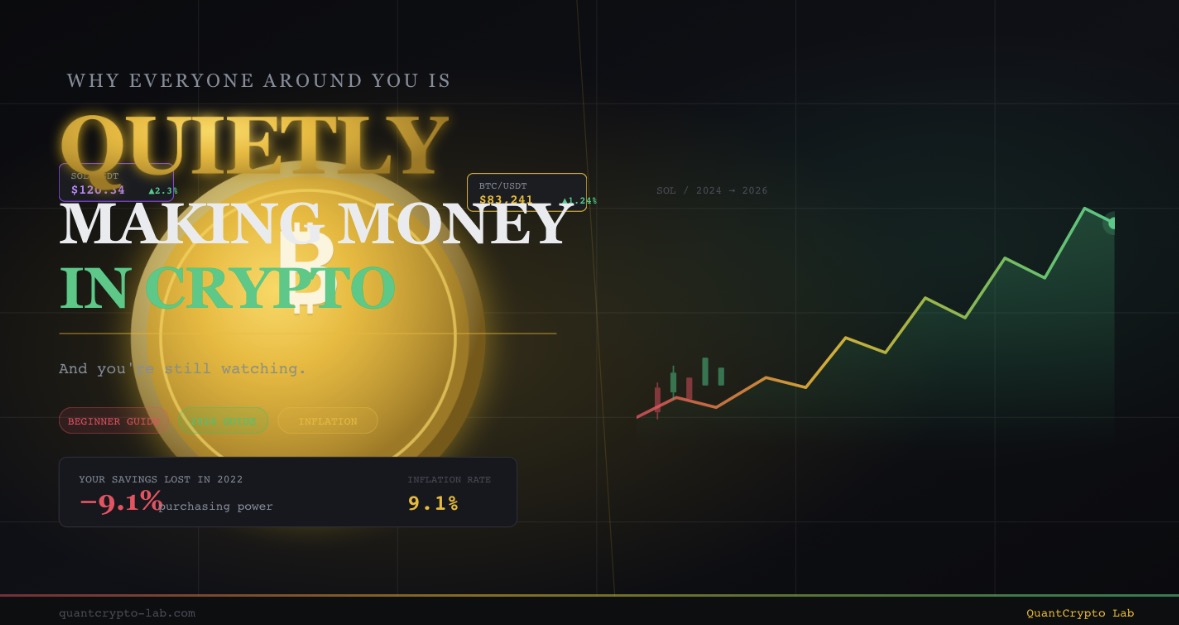
Inflation in 2022 hit 9.1% in the US. That means $10,000 sitting in a savings account paying 0.5% interest… effectively became worth about $9,140 in purchasing power. In one year. Without you doing anything wrong.
You didn’t lose money. The money lost you.
Crypto — specifically assets like Bitcoin — was designed as a response to this. A finite supply. No central bank that can print more of it. No government that can devalue it overnight.
That’s not a sales pitch. That’s the actual origin story.
“But Isn’t It Risky?”
Yes. And so is not knowing about it.
Here’s the reframe most people miss:
Risk isn’t just what can go wrong. Risk is also what you miss when you stay on the sidelines.
In 2020, Bitcoin was $7,000.
In 2021, it hit $68,000.
People who “waited until it was safer” bought at $50,000.
Nobody is saying you should put your savings into crypto. That would be reckless advice.
But there’s a massive difference between gambling your rent money and putting $50 into an asset class you actually understand.
The second one isn’t reckless. The second one is called education with skin in the game.
What Actually Happens When You Buy Crypto
Let’s make this concrete. No jargon.
Step 1. You open an account on an exchange (we’ll get to which one in a second).
Step 2. You deposit money — as little as $10.
Step 3. You buy a fraction of an asset. You don’t need to buy a whole Bitcoin. You can buy $25 worth.
Step 4. That asset now moves with the market. Some days up. Some days down. You watch. You learn.
That’s it. That’s the whole process for a beginner.
The complexity — strategies, leverage, technical analysis — comes later, if you want it. Most people are perfectly fine just holding Bitcoin or Ethereum and checking it once a week.
Why Solana Is the One Beginners Keep Asking About
If Bitcoin is digital gold — a store of value you hold — then Solana is something different.
Solana is a network. Think of it like the internet, but for financial applications. Apps are built on it. Transactions happen on it. And SOL is the currency that powers all of it.
Why do beginners get drawn in?
- It’s fast. Solana processes 65,000 transactions per second.
- It’s cheap. Fees are fractions of a cent.
- It moves. SOL regularly sees 5–10% swings in a day — which means real opportunity for people paying attention.
Is it volatile? Yes. Is that a problem? Only if you don’t have a strategy.
(For anyone interested in what a data-backed SOL strategy actually looks like, I published a breakdown here — 1.927 Profit Factor, tested across 1,847 trades.)
The Honest Truth About “Getting In Late”
People have been saying “I missed it” since Bitcoin was $1,000.
They said it at $5,000.
They said it at $20,000.
They’re saying it right now.
Here’s what that thinking misses: crypto isn’t one event you either catch or miss. It’s an ongoing market with cycles, pullbacks, and new opportunities every single week.
The people making consistent money in crypto aren’t the ones who “got in early.”
They’re the ones who stayed informed, stayed disciplined, and had a system.
That’s a learnable skill. It’s not luck.
The One Thing You Should Do This Week
Not “research for six months.”
Not “wait for the dip.”
Just this:
Open a free account. Deposit $10–$50. Buy a small amount of BTC or SOL. Watch it for two weeks.
That’s it. You’re not betting your savings. You’re buying a front-row seat to the most interesting financial shift of our lifetime — and it costs less than a dinner out.
The exchange I use — and the only one I recommend for beginners based on execution quality, liquidity, and ease of use — is Binance.
What Comes Next
Once you have skin in the game, everything changes. You start actually reading charts instead of scrolling past them. You start asking real questions. You start developing an edge.
That’s when this blog becomes useful to you.
Every strategy I publish here is backed by data — not hunches, not hype. If you’re ready to go beyond “just holding” and start trading with a real system, the next post to read is:
→ The Sweet Spot Strategy: How I Execute the 1.927 Profit Factor Setup on Solana
See you on the other side.
What’s stopping you from getting started? Drop it in the comments — I read every one, and I’ll give you a straight answer.